

If it wasn’t for the forgetting curve, you’d remember everything you’ve ever been taught. That’d make you a genius on a level that would make Einstein envious.
This makes the forgetting curve the arch-nemesis of learning and development (L&D) departments across the globe. But, wouldn’t life be boring if everything was that easy?
In fact, we are lucky to know about the forgetting curve. It tells us important information about our memory and knowledge retention — key ingredients for successful learning. Understanding how the curve works gives you the tools to combat it — and hold on to more of what you’ve learned.
But what exactly is it, and how does it work? This article will run you through the memory model, its history, and ways to combat the curve. Ready for a memorable journey? Let’s go!
What Is the Forgetting Curve?
The forgetting curve is a memory model created by German psychologist Hermann Ebbinghaus. In fact, you might also see the model referred to as Ebbinghaus’ Forgetting Curve.
This memory curve shows how we lose information over time if we don’t try to retain it. As such, understanding this model helps us to combat and conquer memory decay — once and for all!
Ebbinghaus’ Epiphany: Where Did the Model Come From?
In the late 19th century, from 1880 to 1885 to be more specific, German psychologist Hermann Ebbinghaus tested his memory over various periods of time.
He did so by conducting tests on himself to examine his hypothesis. Ebbinghaus’ tests focused on him memorising meaningless three-letter words, like ‘DOK’ and ‘EHD’ (aka CVCs or Consonant–Vowel–Consonant).
He then tested how well he could retain that information after different time periods. Once he’d gathered all the data from his spaced learning studies, he plotted it on a graph that looked a little something like this:
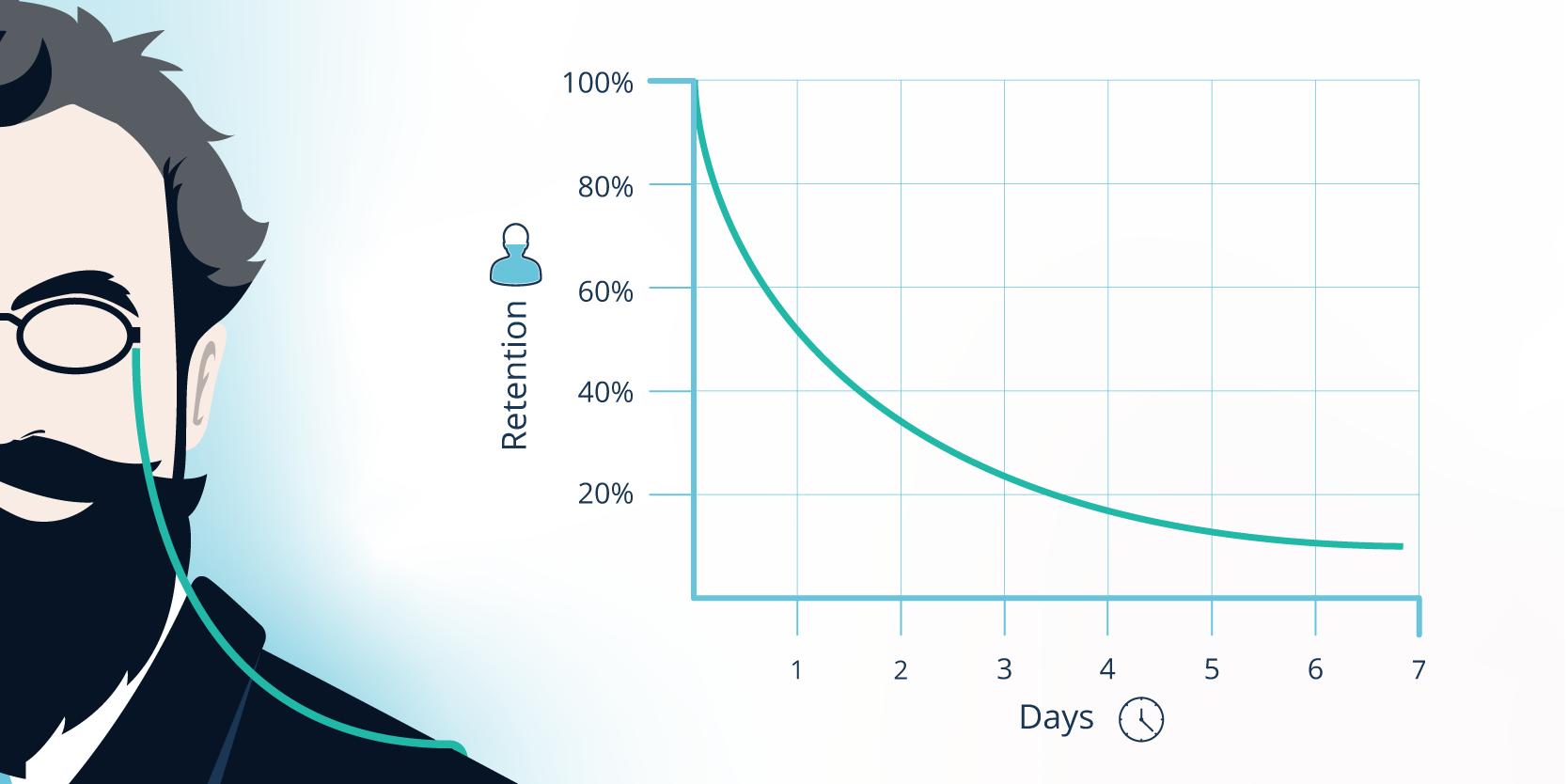
Now, contrary to appearances, Ebbinghaus didn’t invent a fun slide. He’d actually discovered the nature of memory loss over time.
The graph shows what happens to new knowledge without reinforcement: it disappears fast. The steepest drop comes in the first day or two, after which the rate of loss tapers off. Without reinforcement, you are not topping up a memory. You’re paying for it twice. Relearning cost Ebbinghaus:
- 56% of his original effort after 1 hour.
- 66% after 24 hours.
- 75% after 6 days.
After a month, less than a quarter of the original effort was still saved. Isn’t that a painful thought? Well, don’t worry, you’ll have forgotten about it soon enough.
This study was replicated in 2015. The research produced results that ‘are similar to Ebbinghaus’ original data’. Clearly, we shouldn’t discard this model just because of its age.
However, recent research suggests the forgetting curve is more complex than a single smooth drop in retention. One 2022 review proposed that memory changes across distinct phases rather than following one continuous function.
Similarly, 2025 research suggests the shape of forgetting is more nuanced than the classic curve implies. Stronger initial learning may improve later recall without necessarily altering the rate at which memories decay.
That said, the model remains one of the most influential frameworks in modern learning design. Recent AI research has even begun using forgetting-curve-inspired scheduling to improve long-term memory in deep neural networks, underscoring how valuable spaced review is when retention matters.
Next, let’s take a look at the factors that contribute to memory decline.
What Impacts the Decline of Memory?
Based on his research, Ebbinghaus concluded that the level of retention depends on a few different factors.
1. Strength and Relevance
Perhaps unsurprisingly, individuals can recall stronger memories for longer periods than weaker ones. In turn, the relevance of the information has an impact on how strong the memory is.
For instance, if you’re exposed to a presentation on a subject that doesn’t capture your interest, you’ll lose that information quicker than with content you find relevant or engaging. Simple, right?
As such, we remember less and less of our weaker, non-relevant memories as the days go by, particularly if we don’t try to retain the information. This is because our brain is making room for fresher and more important information.
2. Time
In a learning context, the forgetting curve shows that by day six, three quarters of Ebbinghaus’ original learning effort was gone.
As such, without retention, we remember less and less information as the hours and days go by. The biggest drop in retention happens soon after learning, which is reflected by the steep fall at the start of the curve.
This is a great argument for ‘just-in-time‘ learning experiences, or learning in the flow of work. If your training programme has not had the impact you hoped for, now you know why.
3. Presentation
The way information is presented can affect learning and how well we store information. In other words, you can make the same piece of knowledge more or less memorable by changing how you communicate it.
Typically, learners find it easier to remember information that has been organised logically and presented clearly. That way your brain can focus on the content of the message rather than trying to decode it.
4. Feelings
Our feelings also affect how well we remember information. In fact, Ebbinghaus suggested that physiological factors, like sleep and stress, influence how well we retain information.
This is typically because these negative physiological states impact our focus and attention. As a result, we struggle to learn efficiently. Similarly, sleep itself has an important role in the consolidation of memory.
This falls neatly in line with Maslow’s hierarchy of needs. This model categorises and prioritises human needs within a five-tier hierarchy, often presented as a pyramid.
Our basic needs, like physiological needs and safety, are at the bottom. We need to satisfy these lower-level needs before moving on to more complex needs.

Why Does Memory Matter?
It’s simple. Without memory, we could not learn anything at all.
Memory plays a fundamental role in life and learning. After all, it’s the only way we can reflect on the past. This, in turn, helps us to operate in the present and think about the future.
This makes memory essential for our survival. We typically store information that helps us avoid physical or psychological harm. For example, we remember which foods cause us allergic reactions, or which routes to avoid in unsafe neighbourhoods.
With this in mind, it’s essential to combat the forgetting curve to ensure you remember and store new information. But how exactly can you do this?
How to Combat the Forgetting Curve?
This may all sound pretty scary and daunting. In fact, it’s clear that Ebbinghaus’ forgetting curve presents a real challenge for learning and development professionals. After all, your aim is to create an effective training programme your learners will love and remember.
If your learners forget important information before they’ve had a chance to apply it, you won’t see any change in their behaviour or any meaningful impact on your business.
Luckily, now that you understand how memory works, you can do something about it. There are various tactics that you can use to overcome the forgetting curve and make sure you don’t squander your precious learning efforts.
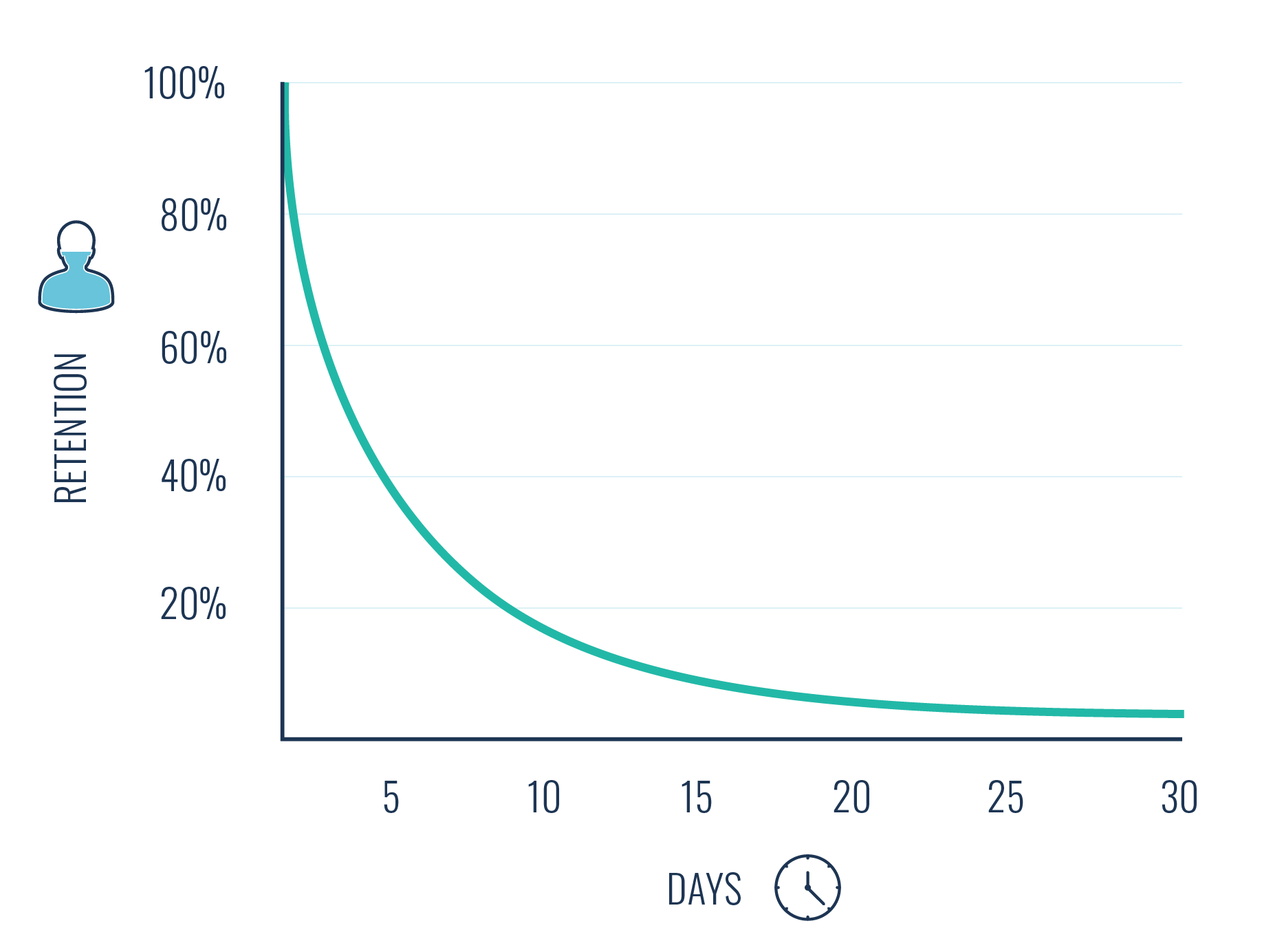
Here are some of our favourite ways to leverage spaced repetition to improve recall throughout your training initiatives.
1. Reinforce Regularly

Ebbinghaus discovered that reviewing information at key points on the curve can help you to reduce the rate at which you typically forget. That’s because you’re exerting real cognitive effort. As such, every time you reinforce your training, the rate of decline decreases.
In fact, simply testing your memory will help it to become stronger. This, in turn, indicates that staging frequent training interventions as part of your learning campaign can help you to solidify new information through active recall. This process is known as retrieval practice.
As the biggest drop happens just hours after learning new information, it’s always a good idea to reinforce training materials within the next few days of the first session.
Similarly, Ebbinghaus discovered that information is easier to recall when it’s built upon things you already know. After all, this helps you to understand the context and relevance behind the material more effectively. As such, try to use as many real-world examples as possible.
2. Improve Clarity

As mentioned previously, presentation matters as it influences how much energy our brains need to devote to understanding the message itself. With this in mind, you should strive to make information easier to absorb in the first place.
Rather than writing everything down in lengthy text formats, present information in diagrams or graphics wherever possible. Similarly, you could create videos or high-impact eLearning courses to help explain new concepts or terms.
The clearer the information, the better your learners’ brains can focus on remembering all relevant details.
3. Keep Things Relevant

We tend to remember information that has personal meaning to us, whereas we lose weak and non-relevant memories in just a few hours.
As such, when it comes to your corporate training initiatives, make sure your content is relevant and has a personal meaning to each learner.
An off-the-shelf learning resource won’t have the same impact as a custom-made one. In every piece of content you produce, keep the core purpose of your organisation and training initiative at the forefront of your mind.
4. Increase Interactivity

People learn better when they’re actively involved than when they’re passive observers. If you don’t give your learners an opportunity to interact with the content, they’ll soon drift off and lose concentration.
There are various ways to increase interactivity and make learning more engaging. However, here at Growth Engineering, we are gamification lovers and experts.
Adding game mechanics to your training programme is an excellent way to engage your learners for longer by making training more fun. Similarly, gamification keeps your learners involved and promotes healthy competition.
Playing a more active role makes the whole training process more relevant to your learners. Similarly, making learning more fun ensures that your audience has the hunger to keep coming back.
5. Make Training Accessible

If you want your training content to stick, you need to make it accessible and convenient for your learners. After all, providing spaced repetition is difficult if you only offer one training session per month.
As such, learners should have the ability to complete training whenever and wherever they want. This is possible with today’s innovative learning technology. For example, Growth Engineering Learning App makes just-in-time learning easier than ever before.
Mobile learning means that your learners have a much better chance of recollecting their knowledge. Similarly, they can refresh their knowledge autonomously at the point of need. Combine mobile learning and microlearning, and you’ll soon see results.
Together, these approaches supercharge accessibility, which helps you to create a more effective spaced learning experience for your learners.
As a recap, make sure to watch what our very own Juliette Denny has to say about different ways of combating the forgetting curve.
5 Common Mistakes That Worsen the Forgetting Curve
So far, we’ve talked about what to do. Now let’s look at the flip side: the most common training mistakes that make the forgetting curve worse — and what to do instead.
1. Cramming Everything Into One Session
There’s something satisfying about a packed training day. Unfortunately, it’s also a recipe for memory loss. Massed practice — what you might call cramming — feels efficient in the moment but produces fragile memory traces that fade fast. The brain needs gaps between sessions to consolidate what it’s learned.
2. Running One-and-Done Training Events

A single workshop or eLearning module is a recipe for forgetting. Without follow-up reinforcement, most of the learning evaporates within a week — exactly as Ebbinghaus would predict. Always plan post-training touchpoints before the calendar invite goes out.
3. Measuring Completion Instead of Retention

Completion rates tell you who clicked through. They tell you nothing about whether the learning actually stuck. To know if your training is working, you need to measure recall — ideally weeks or months after the initial session, not five minutes after the final quiz.
4. Skipping Post-Training Reinforcement

The biggest drop in memory happens within hours of learning. If you don’t follow up with reviews, quizzes, or retrieval practice in the days after a session, you’re letting the curve do its worst. A simple 1-3-7-21 day reinforcement schedule can make a dramatic difference.
5. Forgetting About Personal Relevance
Generic, off-the-shelf content fades the fastest. If learners can’t see how the material applies to their role or goals, the information has no anchor — and the brain happily lets it slip away. Personalised and contextual learning experiences are much stickier.
Final Words
There you have it! Ebbinghaus’ forgetting curve in all of its glory.
It’s true that not all memories follow the curve. After all, there are various factors that influence how strong our memories are.
Even still, the forgetting curve enables you to identify the best approaches for spaced repetition. This, in turn, helps you to ensure that your learners remember what they learn.
In a nutshell, reinforce your training regularly, design clear and meaningful learning experiences, and keep your content interactive. These tips alone will get you off to a memorable start.
The forgetting curve is just one piece of the puzzle. Want more frameworks like it? Download our Guide to Learning Theories and Models to explore the rest.