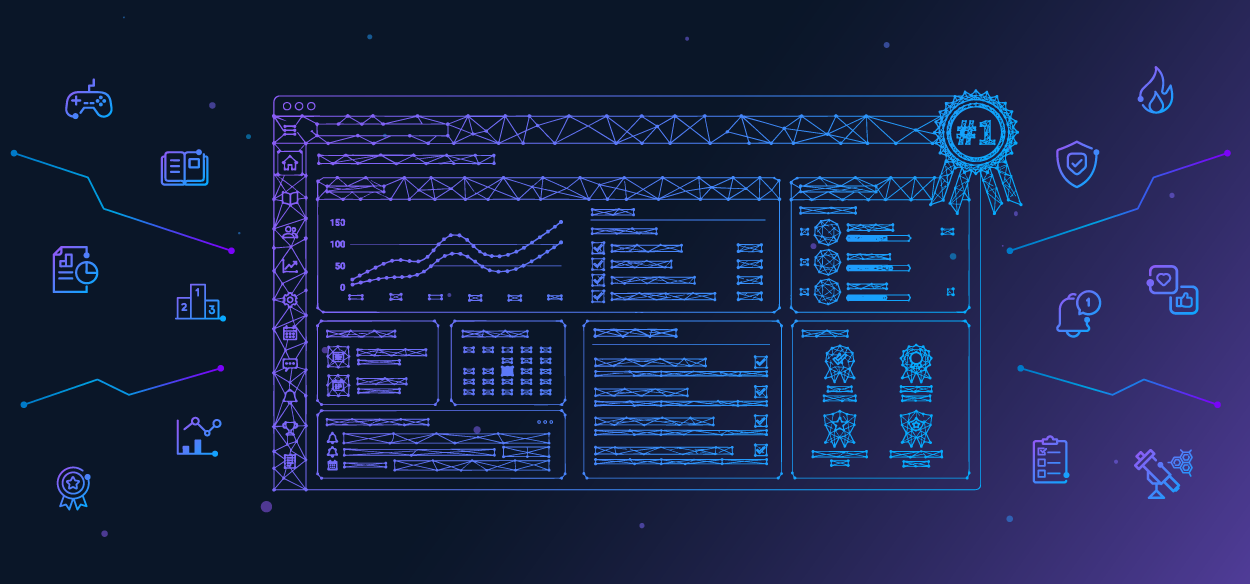
 There’s lots of evidence that gamification – the application of gaming mechanics and metaphors to non-gaming scenarios – is useful in securing employee engagement and getting learners motivated and invested in their online learning programmes.
That’s what we use gamification for, anyway. Our Gamified Social Learning Management System, the Academy LMS, uses gamification to supercharge learner engagement and enjoyment. Find out more about what our Academy can do by taking a tour – just click the link below!
But, in addition to creating online learning that knocks socks off, gamification can also be used in many other ways, from encouraging repeat business for supermarkets to boosting workout success. Let’s focus on one aspect of our lives that I’m sure we can all use a bit of help with: setting and achieving goals.
 We were luckily enough recently to listen to An Coppens – Chief Game Changer at Gamification Nation – speak at the E-Learning 20-20 Seminar. She gave us some excellent ideas on how to gamify goals that we’re going to use here and expand upon. You can check out An’s presentation here, or click here to visit her personal website.
Anyway. An explained that one of the reasons gamification helps to get us motivated and engaged is that so many of us are interested in games and play them regularly – in other words, many of us are ‘gamers’. 53% of gamers are aged between 18 and 49, while only 18% are under 18 (proving the ‘gamers are mostly teenagers’ misconception is just that!) and 29% are aged over 50.
Clearly, age is no barrier when it comes to enjoying games and the gaming mechanics like badges, points and achievements that come with them. So it stands to reason that the effect gamification has on our motivation and engagement will apply no matter our age, situation or the application. Let’s find out more:

Using Gamification to Achieve Goals
An Coppens suggests that when we want to achieve something specific, we should frame the activities in terms of ‘missions’. These missions help to guide us along the correct path, and they shouldn’t be too long, tricky or complicated. Small missions will add up to big goals, after all.
For example, say you wanted to improve your fitness (who doesn’t!?). One mission could be: “Run 3 times in the next 10 days.” Once this mission has been won, you can move on: “Run 3 times in the next 7 days” and “Run one 11-minute mile.” From there, your missions could cycle between length of run (“Run for 30 minutes” or “Run for 1.5 hours total this week”), speed (“All runs under 12-minute miles”) or number (“Run four times in 7 days”).
Can you see how setting little missions help us to move forward towards our overarching goal? These missions are achievable, simple, straightforward and quantifiable. You either achieve them or you do not. Once you can see what you need to achieve and how you can do it, it’s easier to stick to the goal and change your behaviours accordingly.
 You also need to implement some kind of reward or recognition system for when you achieve your ‘mission’ to keep you going. Some people will reward themselves with a fancy coffee when they hit their fitness goal, a meal out, or even put a £5 in a piggy bank when they hit a new personal best.
Alternatively, you can hand over the tracking and rewarding of your goals to an app or webpage, such as HabitRPG to track daily activities, Fitocracy to monitor fitness gains or ChoreWars to make sure everyone at home is pulling their weight to keep the house tidy.
Once ‘boring’ goals are turned into smaller missions and gamified, they’ll seem a lot more achievable. Nothing is beyond your reach when you can break it down into smaller elements to tackle one by one. What will you pick as your next mission?
Read more about gamification by downloading our research paper here!